2026 / ONGOING
Folding source collections into source-grounded LLM Wikis, then optionally unfolding them as courses and explanations.
00 / The experiment
CAN A BOOK BECOME OPTIONAL?
Books make knowledge feel graspable. They give a subject a beginning and an end, then use sequence, examples, and narrative to move a reader between them.
Reference works have almost the opposite character. A dictionary, encyclopaedia, or compressed technical article can be more information-dense, but it removes much of the path that makes an unfamiliar field comfortable to enter. It may be an efficient repository while remaining a poor introduction.
AI suggests a third arrangement: keep the underlying knowledge granular, technical, and interconnected, then generate the path through it when a person actually needs one. The explanation can change with the question, objective, and way of thinking without changing the evidence underneath it.
WikiFold is not an argument that books are already obsolete. It is an experiment in whether they can become optional: whether a source collection can become a persistent knowledge base and be reorganised around its reader rather than permanently bound to one sequence.
LLM Wikis are the medium. WikiFold is the workflow built around them.
01 / Folding a field
FOLDING A FIELD
I began with a practical problem: I wanted to build a broad understanding of business, but “business” is not one coherent subject.
It crosses strategy, accounting, finance, operations, organisational design, innovation, and several neighbouring disciplines. Any individual book provides only one path through that larger territory. Starting with a fixed curriculum would have encoded another narrow path before the field had even been mapped.
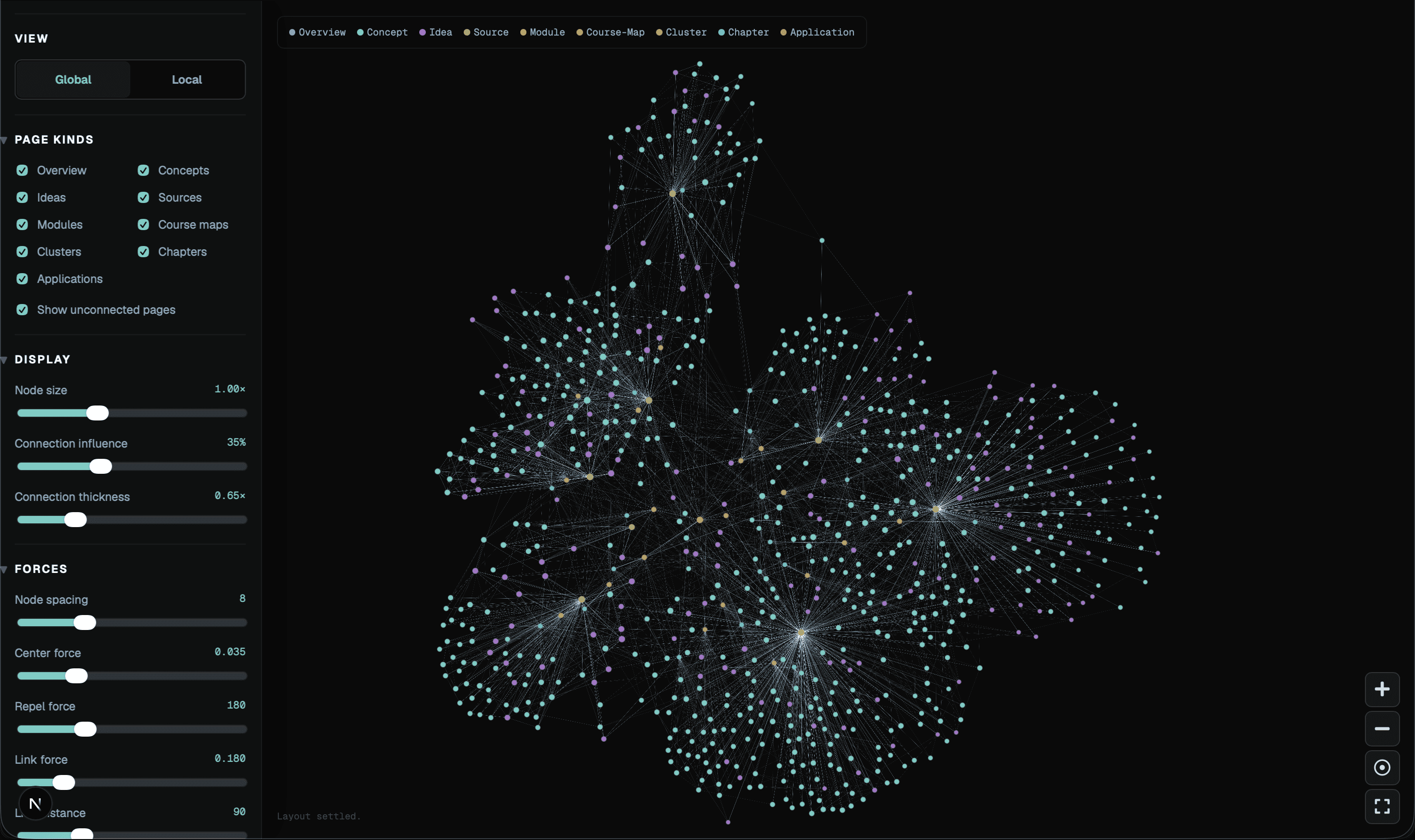
WikiFold therefore begins with the objective. A mapper agent defines the territory, its boundaries, major domains, and source requirements. Once those sources are collected, other agents register and transform them into granular concepts, claims, ideas, citations, and relationships.
The first pilot was not intended to be a summary of eight books. It was an attempt to construct a persistent model of the knowledge distributed across them.
02 / Orchestration
ONE AGENT AT THE FRONT
WikiFold is also an experiment in using Codex as the operating environment for a larger agentic system.
The user speaks to one main orchestrator. That agent manages the workflow and opens specialised tasks for mapping, registration, reading, reconciliation, and teaching. Those tasks can divide their own bounded work among further agents when the corpus requires it.
The experience is meant to remain conversational. If the mapper requested fifteen sources but only nine are present, the system should explain the reduced coverage and ask whether the user wants to proceed. It should not silently narrow the project or turn an imperfect corpus into administrative deadlock.
01Map
A mapper turns the user's objective into a field map, identifies boundaries and disagreements, and proposes a source corpus.
02Register
A registrar inventories the files that actually arrived, records stable source identities, and reports gaps before reading begins.
03Read + write
Reader-Writer agents process the corpus source by source, then reconcile the resulting concepts, ideas, evidence, and connections.
04Teach
After the Wiki is stable, an optional Teacher can cluster it into a durable course and answer questions against the same knowledge base.
03 / The LLM Wiki
THE WIKI IS THE OUTPUT
Once the corpus is available, WikiFold Creator turns it into a filesystem-backed LLM Wiki that can outlive any one model conversation.
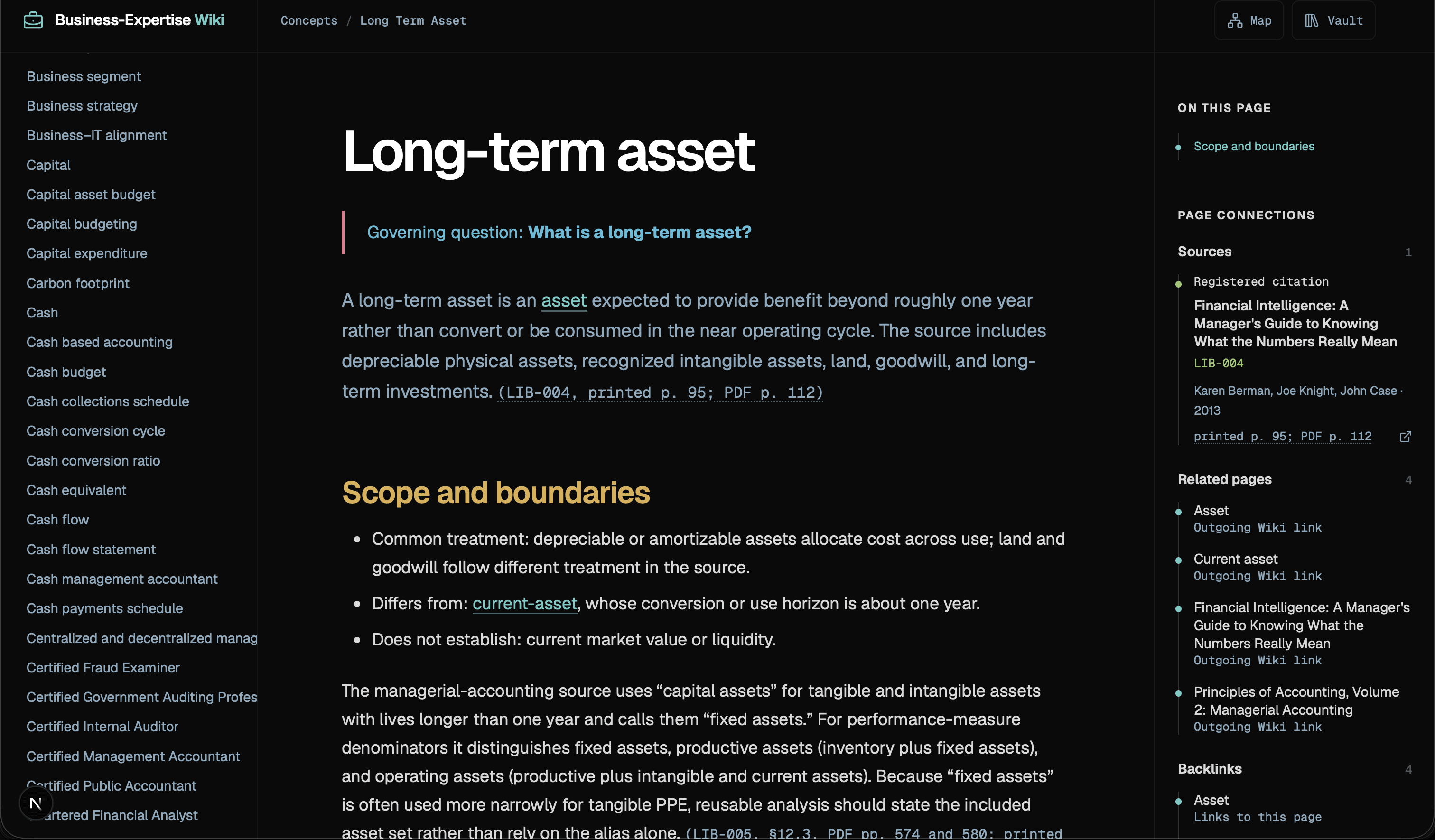
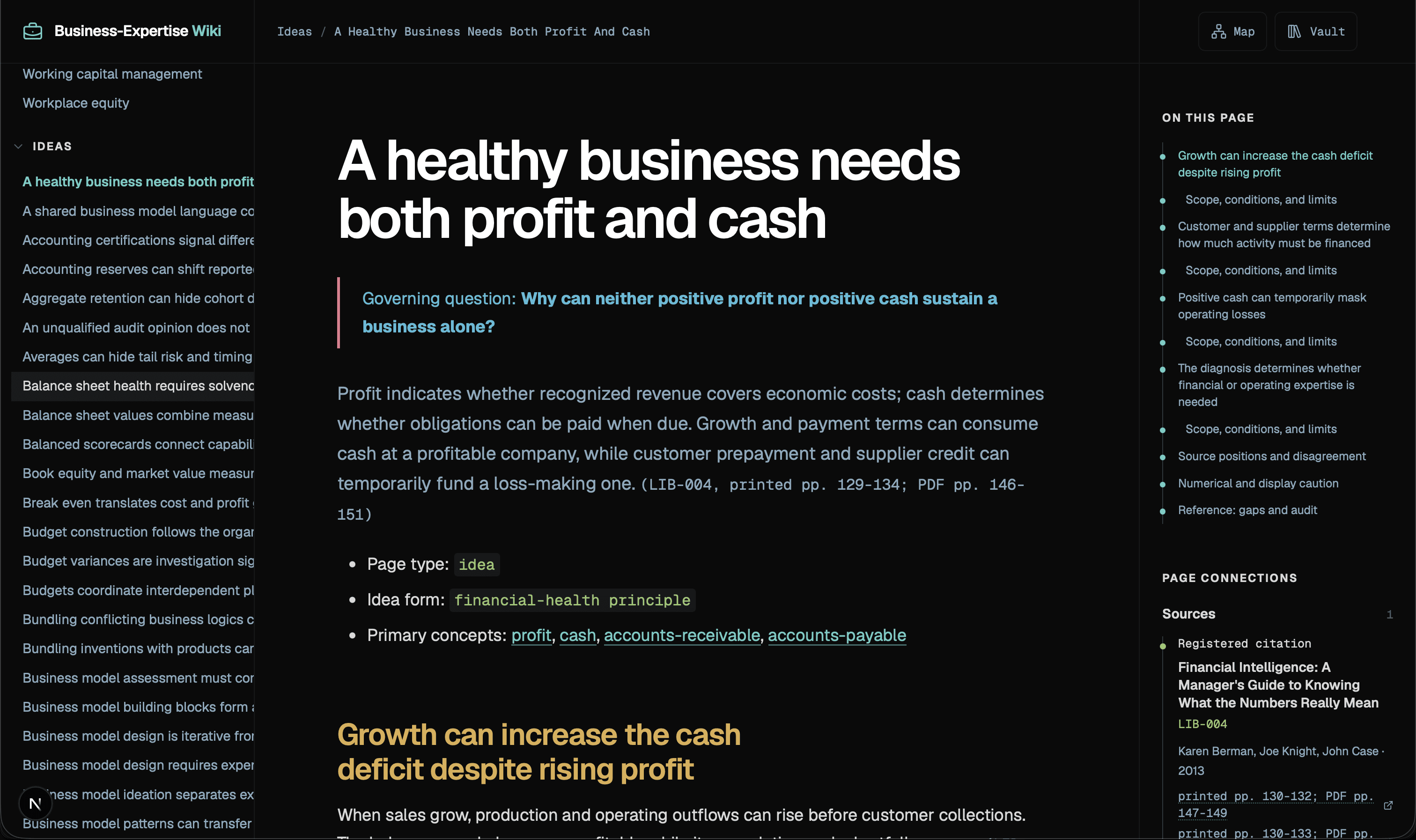
Concept pages define the vocabulary of the field. Idea pages preserve claims, arguments, conditions, and disagreements. Source records retain provenance and citations. Reconciliation connects independently processed sources into a coherent Wiki without asking one model to hold the complete corpus in context at once.
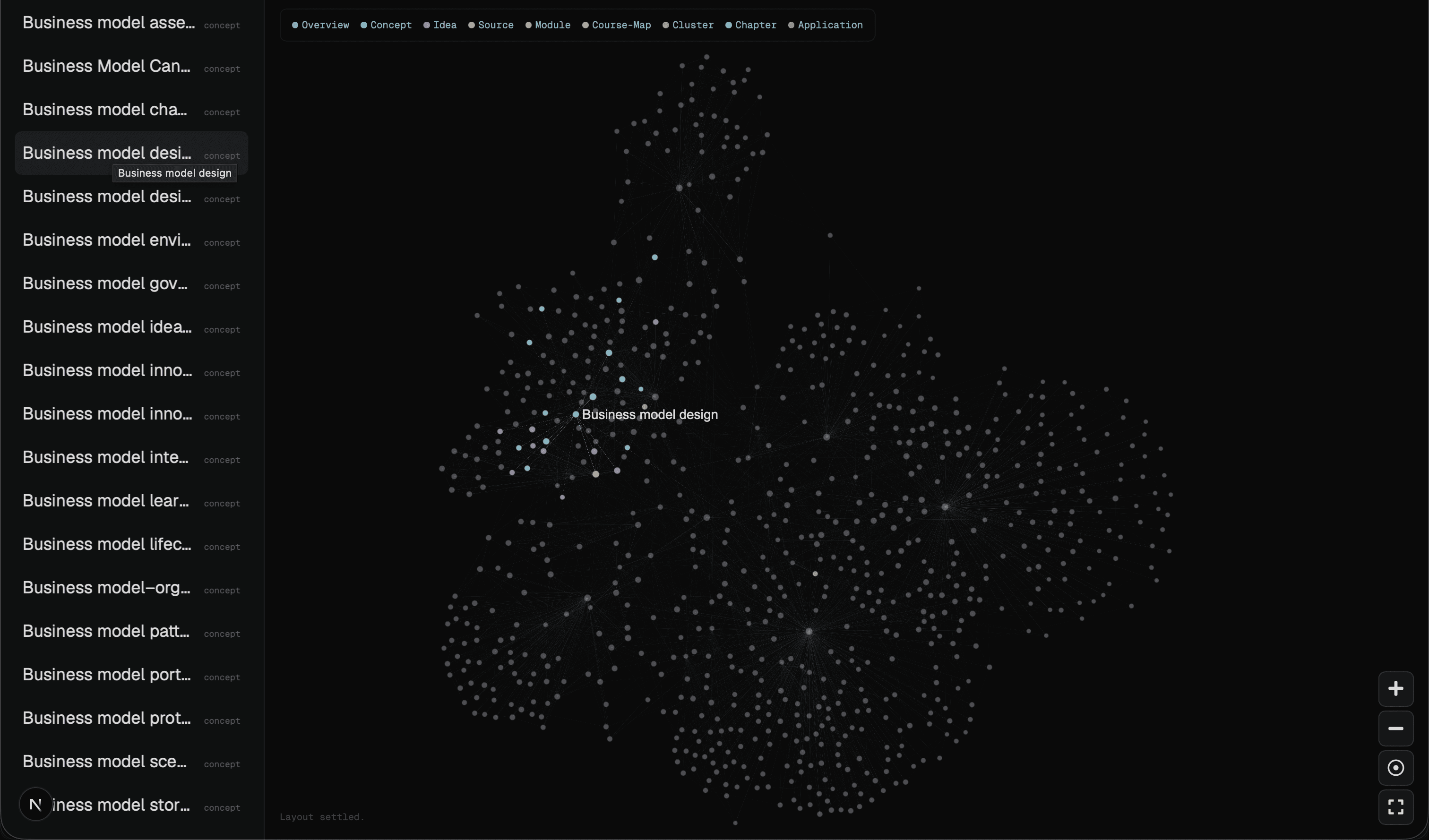
WikiFold Reader exposes the result through ordinary pages, search, citations, semantic connections, and the visual knowledge map. The Wiki is the primary output. Learning is an optional operation performed on top of it.
04 / Unfolding
UNFOLDING FOR A LEARNER
A raw knowledge base is useful for research and reference, but it is not automatically a good course.
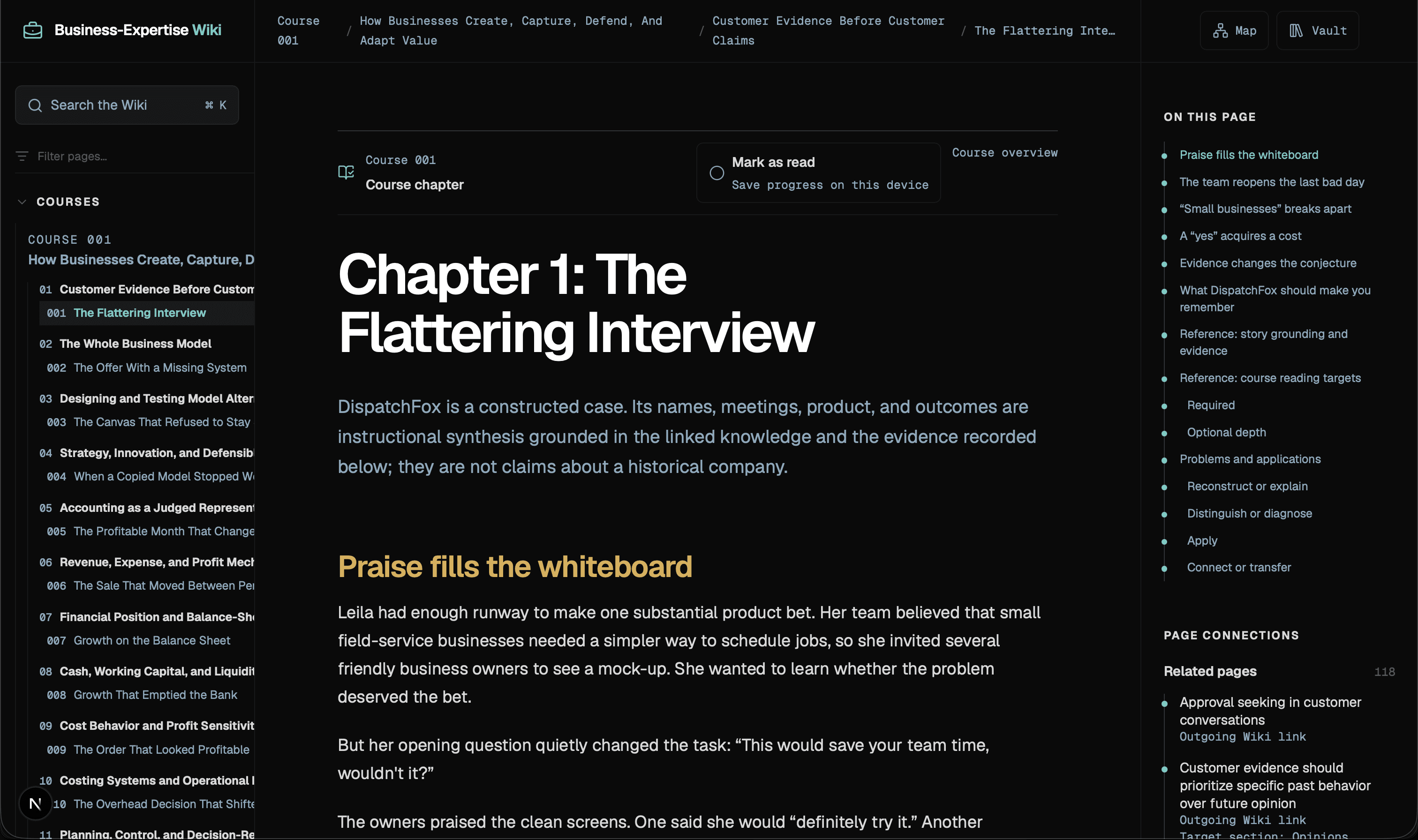
When learning is the objective, WikiFold’s Teacher examines the completed Wiki, identifies meaningful clusters, and generates a versioned course. Each cluster becomes a stage of the curriculum; each stage contains readable chapters that combine the relevant concepts and ideas into a deliberate progression.
The course is generated once as a durable set of files rather than recreated during every conversation. The reader can mark chapters as complete and retain earlier courses when the underlying Wiki later expands. The Teacher remains available for questions about a chapter, concept, idea, source, or connection.
This is the unfolding half of WikiFold: the same source-grounded structure can support different explanations without rewriting the evidence base beneath them.
05 / Limitations
WHAT IT CANNOT YET RECONSTRUCT
WikiFold can currently preserve granular knowledge more reliably than it can preserve pedagogy.
This becomes clear with books whose explanations depend on diagrams, evolving visual models, worked examples, or a carefully designed sequence of representations. The system may extract the individual knowledge points with high fidelity while losing part of the method by which the author made those points understandable.
The Teacher cannot always recover that method afterward because it primarily works from the derived Wiki rather than rereading the complete source corpus. This is not solved by producing more fluent prose. Visual models, derivations, example sequences, and pedagogically essential source structures need to become first-class artifacts during the original reading process.
Until that is solved, WikiFold may successfully map a source without being ready to substitute for the experience of studying it. The ambition is to make books optional, but that claim should only be made where both the information and the means required to understand it survive the fold.
06 / Research maps
RESEARCH SHOULD BEGIN WITH A FIELD MAP
The same architecture points toward a wider problem in academic research: students are still commonly taught to search a field by manually constructing increasingly complicated queries inside institutional databases.
Search competence remains important, but it is becoming an unnecessarily narrow way to interact with a research area. An agent can begin with the researcher’s actual objective, map the relevant territory, identify terminology and neighbouring debates, search multiple systems, compare coverage, and propose a source collection.
The researcher’s judgment does not disappear. It moves toward evaluating the map, the evidence, the omissions, and the quality of the proposed corpus rather than spending most of its time assembling Boolean queries one at a time.
07 / Agentic access
TOWARD AGENTIC ACCESS
In an ideal academic environment, access to a paper would mean more than receiving its final PDF.
A research project could be published as an agent-readable package containing the paper, structured claims, source artifacts, methods, data, chronological experiment records, results, limitations, and the context required to explain how those pieces fit together.
An agent could move from a conclusion to its evidence, from a figure to the procedure that produced it, or from an unfamiliar term to the part of the research that defines it. Members of the public could interrogate the work at the level appropriate to them without requiring the paper itself to perform every explanatory function.
WikiFold is an early exploration of that direction. Its central hypothesis is not that narrative should disappear, but that narrative may no longer need to be fixed in advance. A book can become one possible path through the knowledge rather than the container that permanently defines it.
FOLD THE SOURCES / PRESERVE THE EVIDENCE / UNFOLD THE PATH