Research software · Open development
Agentic Research Workspace
An evidence-linked workspace for humans and agents.
Abstract
Research produces more than a paper: evidence, derivations, code, experiments and a history of decisions. Agentic Research Workspace aims to preserve the connections between them, so that a result can be read, inspected and extended.
The first implemented component is an experimental literature-mapping pipeline. The longer-term goal is a living research workspace and a versioned research pack: a publication that retains the argument alongside the materials and methods behind it.
01 · Research objective
Preserving the work behind a result
A paper tells the story of a result. The research that produced it is a much larger object.
There are intermediate calculations, evolving questions, code versions, experimental setups, failed approaches and decisions about what to try next. Some become supplementary material. Much of the path between them remains scattered across notebooks, folders and conversations.
Agentic Research Workspace starts with a question: what if we preserved those relationships as research happened, then published a navigable representation of the work?
A PDF could remain a useful way to read the argument. It would no longer have to be the container for everything we need to inspect, reproduce or extend it.
The aim is not to automate scientific judgment. It is to make the work behind that judgment easier to follow.
02 · Publication model
From paper to research pack
Design target / not yet implemented
A research pack would be a curated, versioned publication: the narrative together with the claims, evidence and artifacts that give it substance. It should answer not only “what did you find?” but “how did you get here, what supports this, and what can I reuse?”
- Claims & evidence
- Follow an assertion to its source, assumptions, qualifications and unresolved questions.
- Derivations & calculations
- Inspect intermediate steps, symbol definitions and the conditions under which a result holds.
- Code, data & experiments
- Find the exact inputs, code versions, environments and procedures behind a result—not only a picture of it.
- History & decisions
- Understand what was done, when, how, and why the direction changed.
- Limits & reuse
- See what was checked, what remains uncertain, what is omitted and which rights apply.
Conceptual model · shared records
One research pack, two ways in
Human-facing
For a reader
Narrative · graph · derivation walkthrough
Read the argumentAgent-facing
For an agent
Manifest · stable IDs · typed relationships
Traverse the recordsOne versioned pack · the same objects
- supported byE1EvidenceSources & observations
- derived throughD1DerivationSteps & assumptions
- computed withC1CodeImplementation & environment
- usesT1DataInputs & transformations
Identity, provenance and versions stay attached to every record.
03 · Workspace architecture
A workspace that grows with the research
Design target / not yet implemented
The system that grows with a research project needs to retain more than the final pack. It may hold rough notes, competing hypotheses, abandoned experiments, unfinished derivations and private material.
Publishing should be a deliberate transformation: select the relevant records, pin their versions, check their dependencies, handle rights and redactions, and state what is missing. Capturing something must never automatically make it public.
The intended operating model is one project-wide coordinator agent. It can retrieve context across the authorized workspace, create focused tasks or subagents, and integrate their returns into durable project state. Continuity should survive the end of a chat.
That broad view does not grant unlimited authority. Scientific acceptance, external actions and publication remain separate decisions. The current mapper’s deterministic job coordinator is not this future workspace agent.
Conceptual model · publication boundary
From working history to a published release
01 / Capture
Living workspace
Evolving, incomplete, private.
- Notes & questionsRevised as understanding grows
- Experiments & derivationsAttempts, results and dead ends
- Code & data versionsWhat ran, with which inputs
Private and unselected material stays here.
02 / Curate
Publication boundary
A deliberate review, not a sync.
- SelectRelevant records & dependencies
- VerifyEvidence, links & stated limits
- RedactPrivacy & redistribution rights
- Pin versionsExact artifacts & environments
Explicit approval required
03 / Publish
Research pack
A curated, inspectable release.
Published snapshotv1
- Narrative & manifest
- Linked research records
- Code, data & derivations
- Provenance, limits & rights
Pinned versions. Stable references.
Research continues New work can inform a later release. Publishing v2 requires a new review.
04 · Current implementation
Evidence-linked literature mapping
Experimental implementation / v0.1.0-alpha.1
Before preserving research as it happens, we need to understand what already exists. The first implemented part reconstructs source-grounded structure from published literature.
The useful unit is not just a paper or a summary. It is an assertion, a reasoning step, a piece of evidence, and the relationships that make those parts intelligible.
- 01 / Sources
Register the original asset and preserve its identity.
- 02 / Evidence
Link source-local assertions, reasoning moves and argument threads to exact evidence spans.
- 03 / Records
Validate structure and references, then compile canonical Markdown into a graph.
- 04 / Relationships
Record potential support, qualification, equivalence and tension without erasing each source’s position.
- 05 / Navigation
Search and explore records with evidence and context, through human-readable output or JSON.
A structurally valid graph is not proof of scientific correctness or faithful interpretation. Inferred connections remain explicitly potential.
05 · Case study
A corpus, at several scales
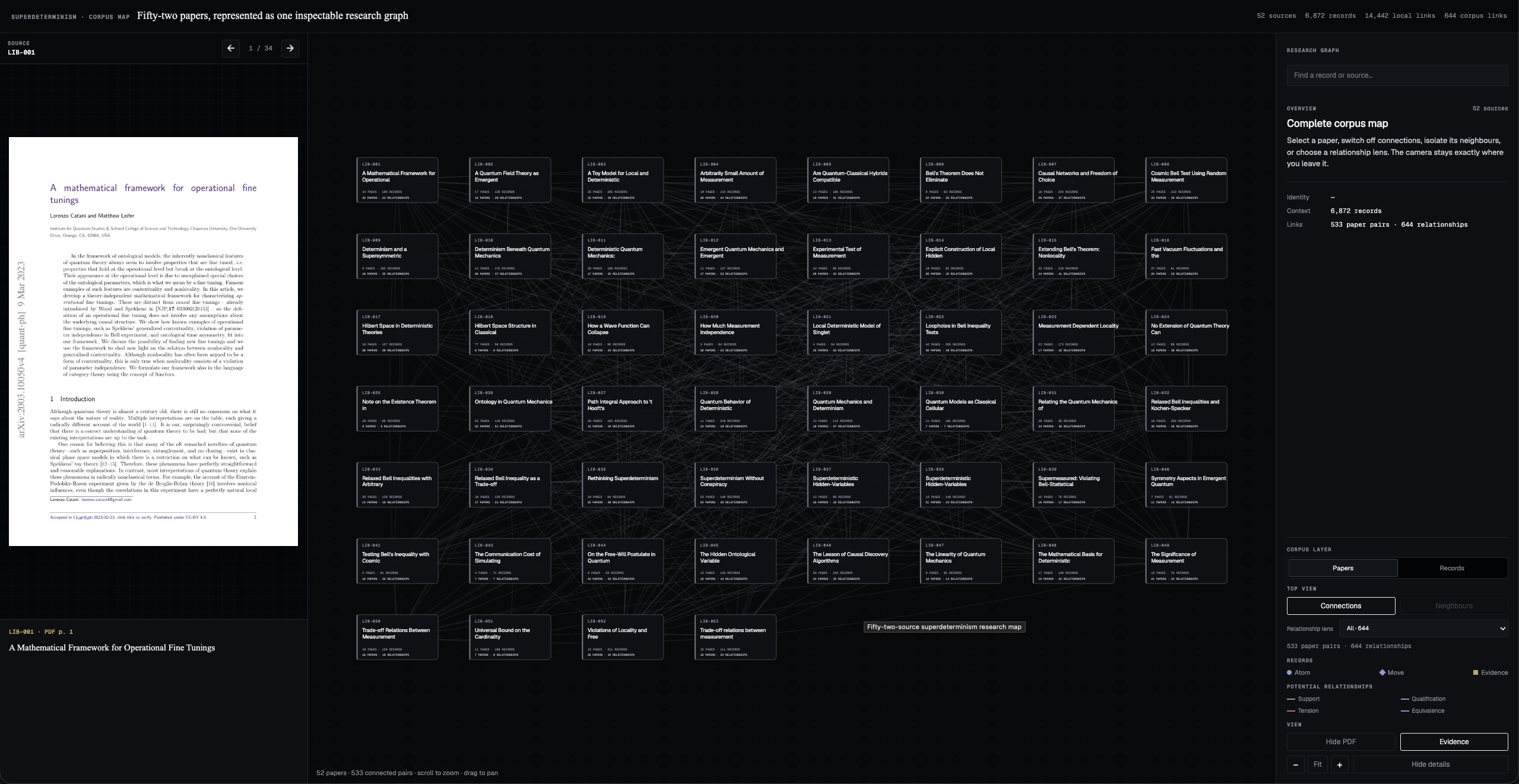
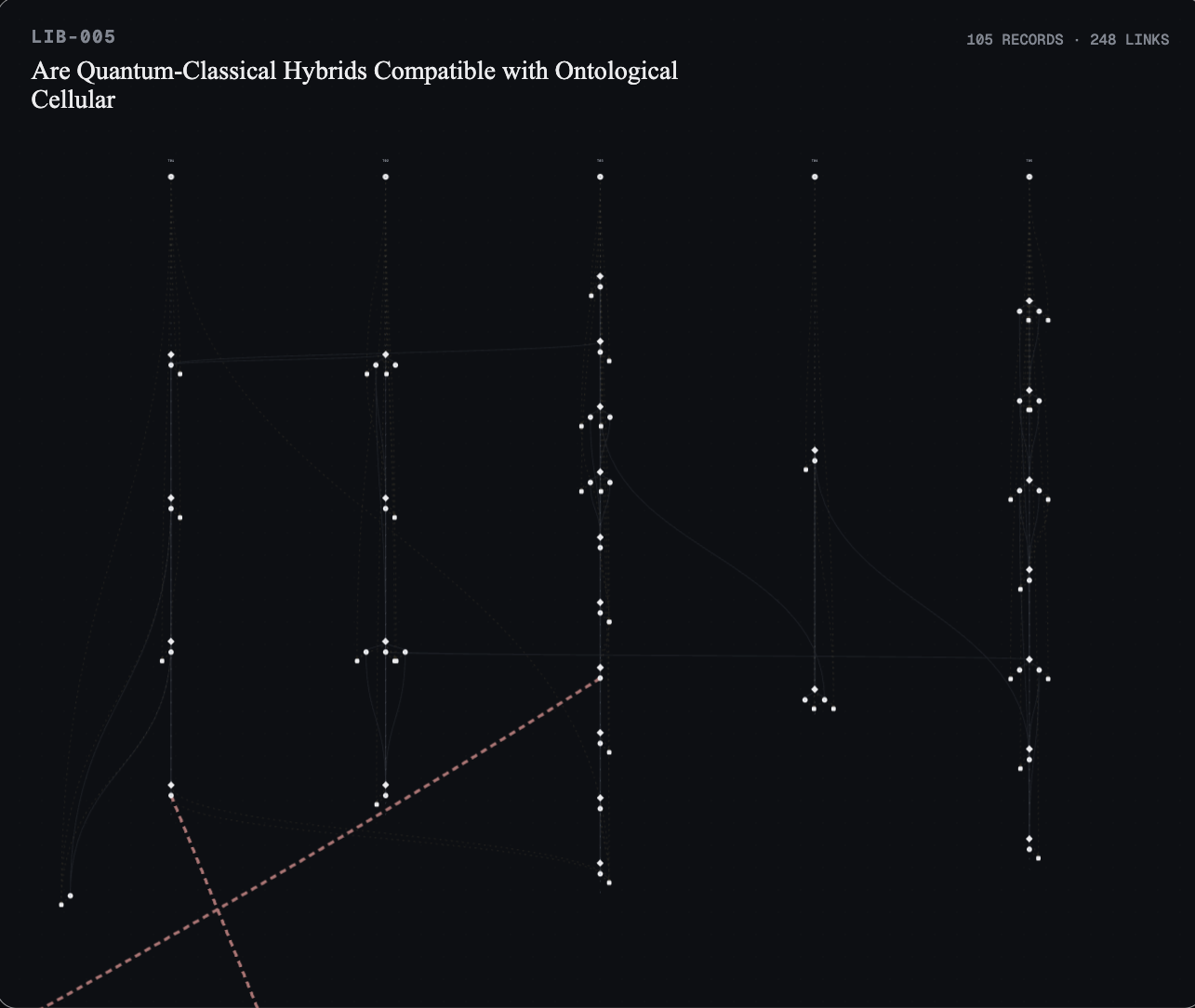
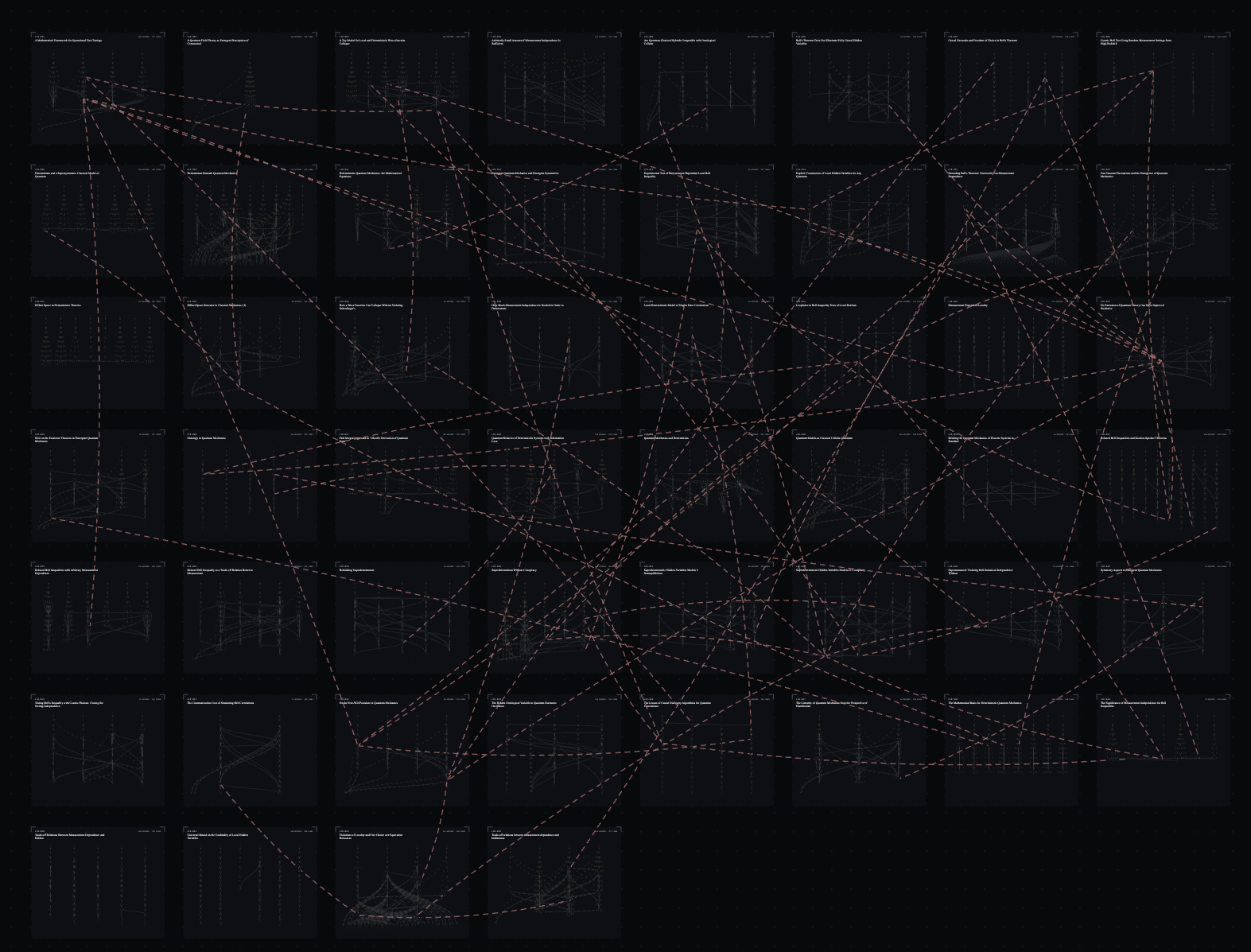
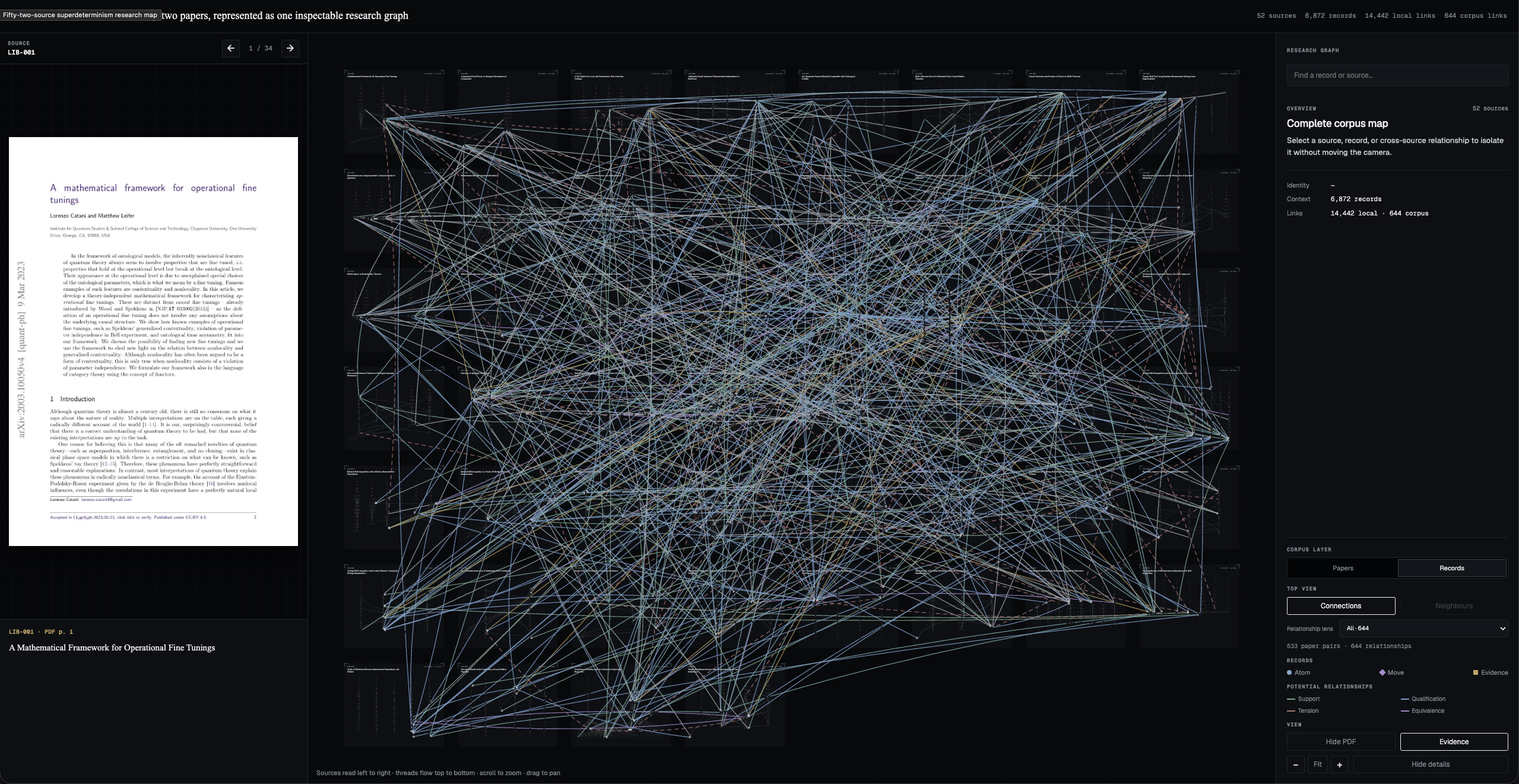
Superdeterminism is the testing corpus, not the identity or domain limit of the project. It gives us a concrete collection of papers against which to test evidence routing, argument structure and cross-source navigation.
The pictured 52-paper baseline contains 6,872 records, 14,442 source-local links and 644 potential cross-source relationships. These are counts of retained output, not measures of completeness or correctness. Audit depth is uneven, and many sources remain provisional.
All four screenshots on this page show that private research viewer. They illustrate the direction; they are not a live demo of an application included in the alpha.
06 · Status & roadmap
Current limits and next steps
The first public release is an experimental literature-mapping baseline. Its easiest entry point is a model-free, source-checkout example: an invented source and manually authored dossier compile into six records and nine links, with zero model calls. It tests the record-to-graph path; it does not demonstrate live extraction.
The release is not a complete research IDE, hosted service or research-pack publisher. The pictured viewer, a self-contained package installation, and later long-form ingestion work are not included.
The next design milestone works backward from publication: build one small reference pack that a person can read, an agent can navigate, and someone else can use to trace a result to its inputs. That should tell us what the living workspace needs to capture.
- Now
Make the mapper inspectable
Public source, an experimental release and rights-safe examples. Viewer and usability improvements are tracked next work.
- Next
Define the research pack
Ground the publication contract in concrete human and agent journeys.
- Later
Grow the living workspace
Derive progressive capture and coordinator-led workflows from what the pack needs.
An outcome roadmap, not a delivery schedule.